The Uncanny Valley
Or, why almost-human is worse than not-human at all.
In 1970, a Japanese robotics professor, Masahiro Mori, published a short essay in an obscure journal called Energy. He called it Bukimi no Tani, “The Valley of Eeriness.” In English, it as The Uncanny Valley.
Mori’s idea was simple. As a thing becomes more human-like, we warm up to it but up to a point. A stuffed bear, a cartoon, an industrial robot shaped like a friendly arm, which are all very charming. Then somewhere near the top of the curve, something breaks. The doll’s eyes are too glassy. The prosthetic hand is too close to skin. The wax figure almost breathes. Affinity collapses into dread. Only when likeness becomes indistinguishable from the real does warmth return.
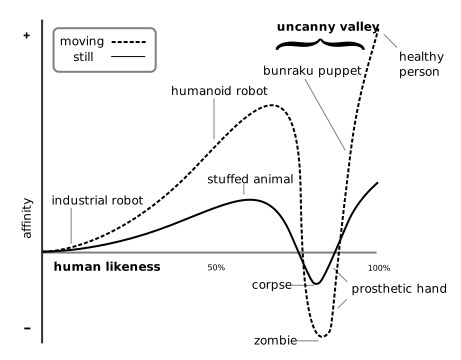
The original essay does not dramatize the valley; rather, it just advises designers to stop short of it. Don’t aim for perfect human likeness. Aim for a safe plateau, a place of affection without deception. The goal is to belong without pretending. It was a deeply humble essay. A robotics pioneer telling his own field to settle for less.
The uncanny valley effect is a hypothesized psychological and aesthetic relation between an object’s degree of resemblance to a human being and the emotional response to the object.
Half a century later, the trench is no longer about androids and prosthetic hands. It runs through our inboxes, our timelines, our phone calls. A voice that almost breathes. A paragraph that almost thinks. A face in a generated video that almost blinks the way a face should. The discomfort we feel is that Uncanny Valley rediscovered in text and pixels.
The instinct to dismiss the feeling, to call people hysterical, sentimental, or behind the times, misses Mori’s point. The valley is how we sort the living from the uncannily still, the genuine from the rehearsed, the friend from the thing wearing a friend’s face.
When something feels off, the feeling is the signal. I have learned to trust that small shudder more, not less, as the imitations get better.
Mori’s counsel still holds. Maybe we do not need machines that pass for us. Perhaps we need machines that are unmistakably machines—useful, legible, and honest about what they are. A well-shaped spoon never pretended to be a hand. It was a better tool for it.
The Uncanny Valley is not a problem to be bridged. It is a line that teaches us where the human ends and the costume begins.
References
- The Uncanny Valley, Masahiro Mori, 1970. Translated by Karl F. MacDorman and Takashi Minato.
- IEEE Spectrum’s The Uncanny Valley: The Original Essay by Masahiro Mori
- The Uncanny Valley and the Rising Power of Anti-AI Sentiment